
AI Text Watermarks Explained: What They Can and Cannot Prove
Learn how invisible AI text watermarks differ from AI detectors, why results need context, and what writers and editors should check.

Have you seen the discussion about invisible watermarks in AI-written text and wondered whether your writing will now carry a hidden label? The idea sounds simple: a tool marks the text, and another tool identifies it. The conclusion people draw from that result is the difficult part.
I would not treat a watermark as a score for whether an article is good, accurate or original. It is a provenance signal. In this explainer, we will look at how that signal differs from a visible label, why detection has limits, and how I would use it without jumping to the wrong conclusion.
What is an AI text watermark?
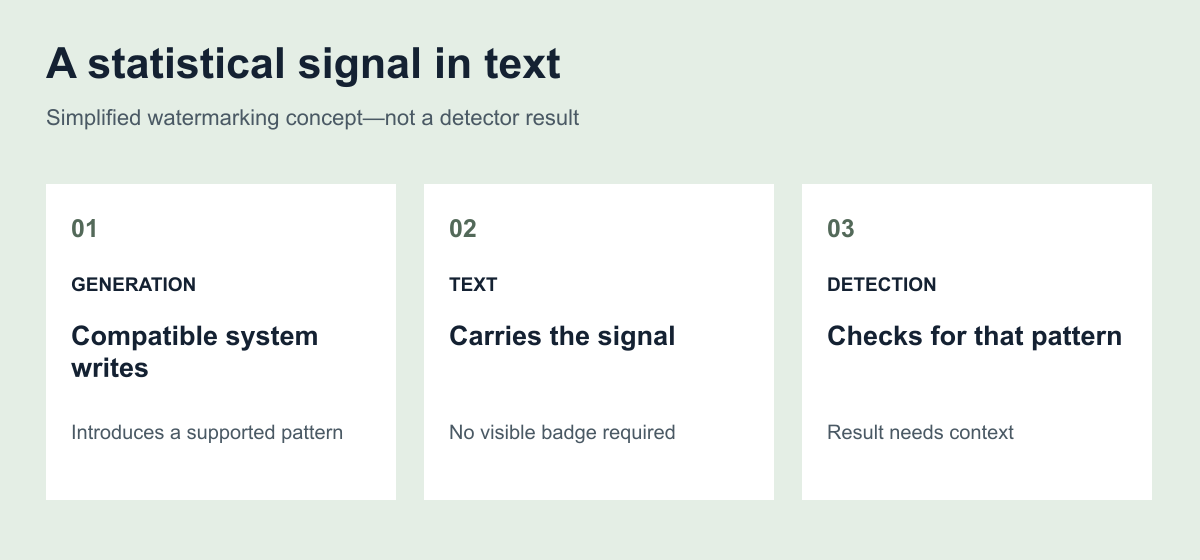
A text watermark can be a statistical pattern introduced while a model selects the pieces of text it generates. It is not necessarily a badge, footer or unusual phrase you can spot by reading. Google’s SynthID explanation describes changing token probabilities during generation so a detector can look for the resulting pattern.
The important distinction is intent. A watermarking system is looking for a particular signal introduced by a compatible generator. It is not simply deciding that your writing sounds polished or that a sentence uses a familiar expression.
A watermark detector is not the same as a general AI detector
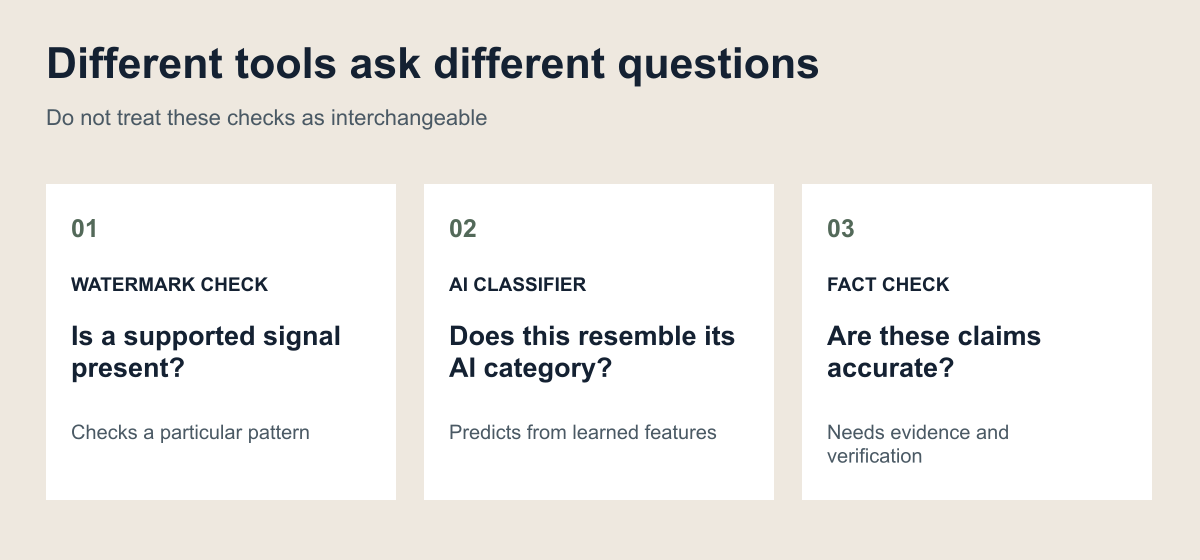
A general classifier estimates a category from the text it sees. A watermark detector looks for a supported watermark pattern. Those are different questions, even when both tools are described casually as AI detectors.
I would ask what the tool actually checks before trusting its label. Which generators does it support? What does its result mean? Is it reporting a statistical signal, signed file metadata or a general prediction? A confident-looking interface does not answer those questions for you.
For example, OpenAI’s content provenance documentation separates its image and audio checks from text verification. It says text access is currently limited to approved organisations, and its provenance tools are not universal detectors for every company’s AI output.
Why a negative result is not proof of human authorship
Google says thorough rewriting or translation can reduce the confidence of its text watermark detection. It also describes weaker effectiveness on text with limited room for different wording. This is a limitation of the signal, not a reason to assume every negative result identifies a human author.
Think about the question being asked. If a tool searches for one supported pattern and does not find it, the narrow result is that it did not find that pattern. Expanding that into a statement about every possible writing tool, or the entire history of a document, goes beyond the evidence.
For an editor, I would keep the original drafts and revision history where appropriate. They give you context a single pasted passage cannot supply.
Why a positive result is not a quality score
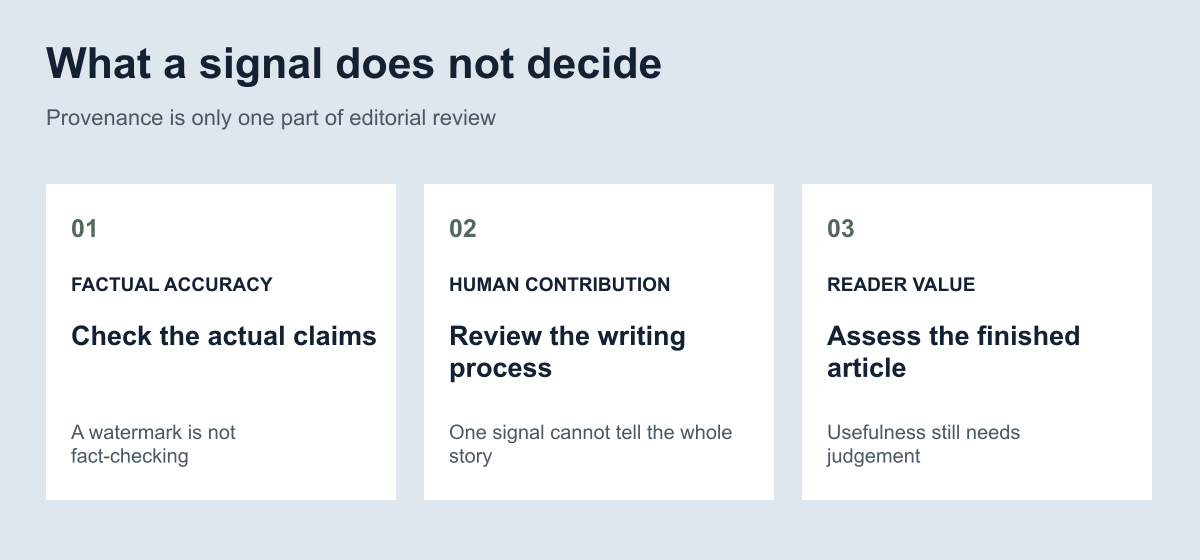
Suppose a passage contains a supported watermark. That still does not check the facts, establish whether an image is relevant, or tell you whether the article answers the reader’s question. Those need their own checks.
It also does not settle how you should evaluate the work. A useful editorial process asks what the writer contributed, which claims were checked and what the publication’s rules allow. Reducing those questions to one detector label would miss the actual work of editing.
My view is straightforward: provenance can help you ask better questions. It should not replace the questions.
What this means for website owners and writers
For a website like Gizmoindex, I would keep the focus on the reader. Does the introduction answer the query? Are the specifications current? Does the buying advice explain who the product suits? Are the supporting images showing the right thing? A watermark result cannot do that editorial job.
I would also avoid advertising any detector as a guaranteed way to establish authorship. If you use a provenance tool in your workflow, record which tool you used, its supported content and its limitations. Do not silently turn an uncertain signal into a definite accusation.
For SEO, my recommendation is to build genuinely useful pages rather than chase a detector score. Write a clear title, answer the question early, explain the details and remove repetition. That is an editorial approach, not a promise that a watermark will improve or harm rankings.
The workflow I would use
First, check the claim or passage itself. Next, examine any available provenance result within the tool’s stated scope. Then compare it with the drafting history and relevant publishing rules. Finally, decide whether the content needs correction, disclosure or more review.
Do not upload a private manuscript or confidential document to an unfamiliar checking website just because it offers a free score. Understand its data handling before sending content to it.
My verdict
AI text watermarks can add useful information about compatible generated text. They are not a universal authorship test, and they are not a substitute for research, editing or judgement.
I would use them as one piece of context. Good writing still has to do the work: say something worthwhile, explain it clearly and give the reader accurate information they can use.
Frequently asked questions
Can I see an invisible text watermark by reading?
Not as an ordinary visible badge. Statistical watermarking is intended to create a machine-detectable pattern rather than a label in the article.
Does no watermark mean no AI was involved?
No. A tool may not support the generator or the signal may be weak or absent. A negative result is not a universal authorship certificate.
Can a watermark verify that an article is accurate?
No. Accuracy requires checking the claims. Provenance and factual correctness are different questions.